 The Editor
Keralam’s Introduction
Keralam, officially known as Kerala, is one of India’s most culturally rich and historically significant states. Located in the southern part of the country along the Arabian Sea coast, it is known for its literacy rate, backwaters, classical arts, and progressive social indicators. Over time, the state has been popularly called Kerala in English, while “Keralam” remains its traditional name in the Malayalam language.
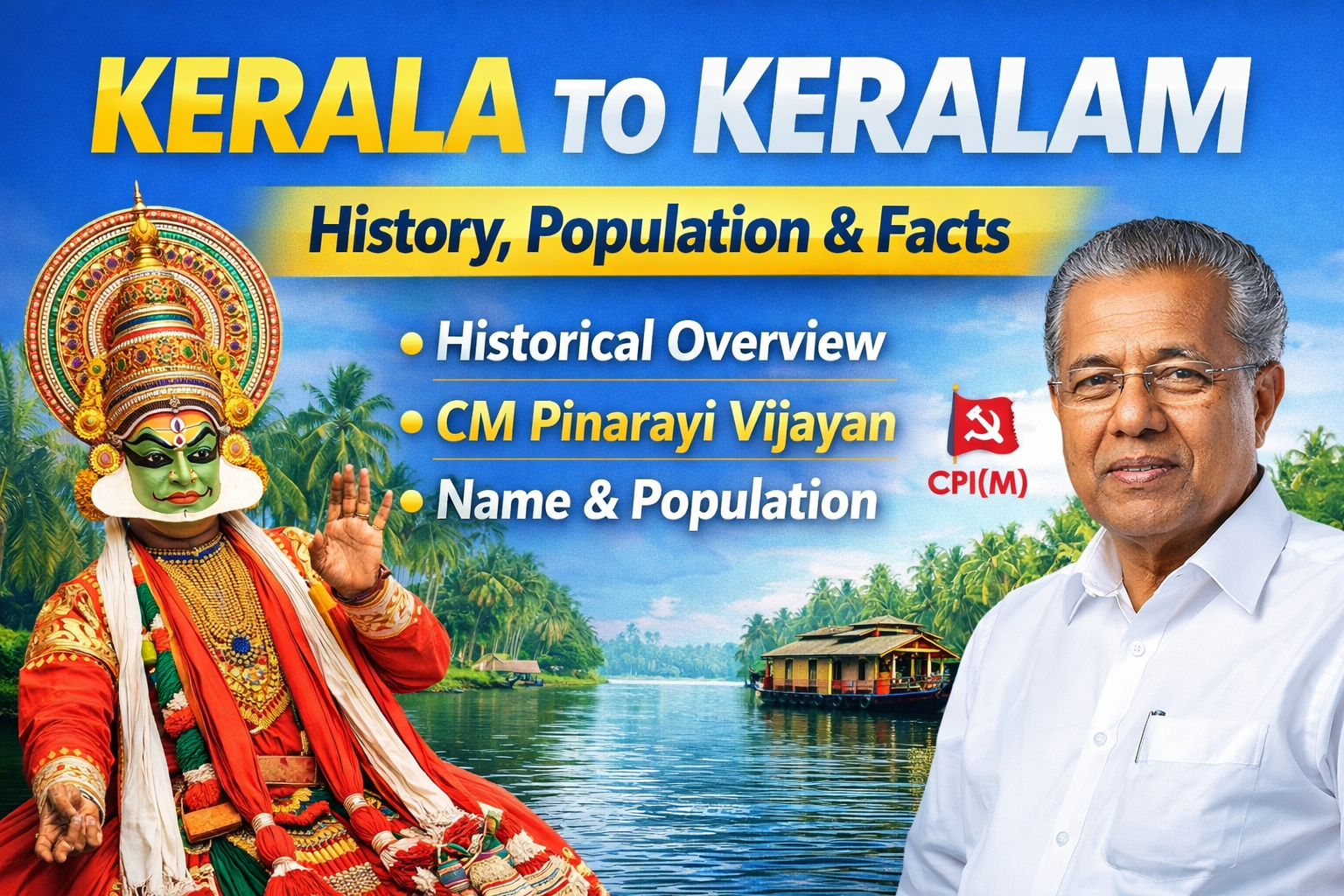
In this article, we explore the full history of Keralam, the origin of its name, linguistic background, total population, and the current Chief Minister with party affiliation.
Origin of the Name: From Kerala to Keralam
The original name of the state in the local language is “Keralam” (കേരളം).
- The word is believed to be derived from “Kera”, meaning coconut tree in Malayalam.
- “Alam” means land or region.
- Thus, Keralam translates to “Land of Coconuts.”
When the British began documenting Indian regions in English, the name “Keralam” was anglicised to Kerala. Even today, the Constitution of India recognizes the state as Kerala in English, while Malayalam speakers use Keralam.
There has been public discussion in recent years about officially renaming Kerala back to “Keralam” in central records to match its Malayalam pronunciation.
Ancient History of Keralam
Early Settlements
The history of Keralam dates back to ancient times. Archaeological findings suggest human habitation from the Neolithic period. The region was known for its spice trade, especially black pepper, cardamom, and cinnamon.
Chera Dynasty
One of the earliest powerful dynasties was the Chera dynasty, which ruled large parts of present-day Kerala and Tamil Nadu. The Cheras were mentioned in ancient Tamil Sangam literature.
Kerala maintained active trade relations with:
- Ancient Rome
- Arabs
- Chinese merchants
The spice trade made Keralam globally significant centuries ago.
Medieval Period
During the medieval period, Keralam was divided into several small kingdoms, including:
- Zamorin of Calicut
- Kingdom of Travancore
- Kingdom of Cochin
In 1498, Portuguese explorer Vasco da Gama landed at Calicut (now Kozhikode), marking the beginning of European colonial influence in Kerala.
After the Portuguese, the Dutch and later the British established control over different parts of the region.
Formation of Modern Kerala (1956)
After India gained independence in 1947, the region was divided into:
- Travancore
- Cochin
- Malabar district (under Madras Presidency)
On 1 November 1956, under the States Reorganisation Act, the Malayalam-speaking regions were merged to form the state of Kerala. This unification was based on linguistic identity.
Thus, modern Kerala (Keralam) was officially formed in 1956.
Language of Keralam
The official language of Keralam is Malayalam.
Origin of Malayalam
Malayalam belongs to the Dravidian language family. It evolved from Tamil around the 9th century CE. Over time, it developed its own script and literary tradition.
Malayalam has:
- A unique script
- Rich classical literature
- Influence from Sanskrit and Tamil
It is spoken by the majority of the state’s population and also by Malayali communities worldwide.
Total Population of Keralam
According to the 2011 Census of India:
- Total Population: 33.4 million (approx. 3.34 crore)
Kerala has one of the highest literacy rates in India, above 90%. It also has:
- High life expectancy
- Low infant mortality rate
- Strong human development indicators
The population is religiously diverse, including Hindus, Muslims, and Christians living together peacefully.
Current Chief Minister of Kerala
The current Chief Minister of Kerala is:
Pinarayi Vijayan
- Political Party: Communist Party of India (Marxist) (CPI-M)
- Alliance: Left Democratic Front (LDF)
Pinarayi Vijayan has been serving as Chief Minister since 2016 and was re-elected in 2021, making history as the first Kerala CM to be re-elected after completing a full term in decades.
Cultural Importance of Keralam
Keralam is famous for:
- Classical dance form Kathakali
- Mohiniyattam
- Ayurveda
- Backwaters of Alappuzha
- Hill stations like Munnar
It is often referred to as “God’s Own Country” due to its natural beauty and tourism appeal.
Economy of Kerala
The economy of Kerala depends on:
- Agriculture (rubber, spices, coconut)
- Tourism
- Remittances from Gulf countries
- IT and service sector
Kerala’s development model is often studied for its strong social indicators despite moderate industrialisation.